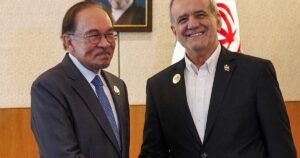
Malaysia and Iran Hold First Face-to-Face Talks at BRICS Summit, with Hormuz Shipping Safety at the Centre of Agenda
PM Anwar Ibrahim and Iranian President Pezeshkian meet at BRICS Summit to discuss Strait of Hormuz shipping safety, bilateral trade, and West Asia stability.
Prime Minister Anwar Ibrahim and Iranian President Masoud Pezeshkian met in person for the first time on the sidelines of the 18th BRICS Leaders’ Summit in New Delhi on Saturday, September 12, 2026, with safe maritime passage through the Strait of Hormuz, bilateral trade, and West Asia de-escalation forming the three pillars of a meeting years in the making.
New Delhi hosted the 18th BRICS Leaders’ Summit this week, and on the sidelines of that multilateral gathering, Prime Minister Anwar Ibrahim and Iranian President Masoud Pezeshkian held their first in-person bilateral meeting — a conversation that centred squarely on Strait of Hormuz shipping safety, regional stability in West Asia, and a broadening of economic ties between Kuala Lumpur and Tehran.
The two leaders had spoken by telephone on multiple occasions since Pezeshkian assumed the Iranian presidency in July 2024, but Saturday’s encounter in New Delhi marked the first time they sat across from each other directly. With Malaysia holding an active interest in unimpeded maritime traffic through the Hormuz corridor — a waterway critical to global energy flows and Southeast Asian trade routes — the timing and substance of the meeting carried weight beyond the diplomatic formality.
Diplomatic Ground Is Already Established, But This Meeting Represents a Shift in Register
With several telephone calls already logged between the two heads of government, the relationship between Anwar and Pezeshkian entered Saturday’s meeting with existing scaffolding in place. What changed in New Delhi was the register: a face-to-face bilateral on the sidelines of a 23-member summit signals deliberate priority, not a corridor courtesy.
This is not a routine diplomatic check-in. Malaysia’s engagement with Iran at this level reflects a calculated positioning — one that spans maritime security, energy economics, and the halal trade architecture that connects both countries.
A demand for Hormuz safety guarantees, a call for West Asia dialogue, an argument for expanded bilateral trade, and a reaffirmation of long-standing diplomatic ties — these were the four structural elements Anwar brought to the table in New Delhi, each reinforcing the others in a coherent strategic frame.
The meeting comes against the backdrop of a year in which shipping disruptions in the Strait of Hormuz created direct operational consequences for Malaysian vessel operators, elevating what might otherwise be a foreign-policy abstraction into a matter of commercial urgency for Kuala Lumpur.
From Hormuz Shipping Lanes to Halal Industry Cooperation, a Full Bilateral Agenda Unfolded in New Delhi
The bilateral session covered ground across at least five distinct sectors, with maritime security serving as the most immediate pressure point. Anwar stated explicitly that the freedom and safety of ships transiting the Strait of Hormuz must be maintained in accordance with international law — a position that carries particular resonance given Iran’s geographic command over the strait’s northern coastline.
Malaysia’s concern over the continuing conflict and escalation across West Asia was also formally registered. Anwar urged all parties to return to dialogue and diplomacy, a call consistent with Malaysia’s long-held non-aligned posture on Middle Eastern conflicts but one that takes on added urgency when Malaysian-owned vessels have been directly caught in the fallout.
On the economic side, the two leaders discussed expanding trade and investment in energy, agriculture, palm oil, food security, and the halal industry — a cluster of sectors where both countries carry genuine complementary capacity. Malaysia’s position as one of the world’s leading palm oil exporters and its established halal certification infrastructure make it a natural partner for an Iranian market of nearly 90 million consumers with strong demand for certified products.
Technology collaboration and higher education cooperation were also explored, with both leaders reaffirming the diplomatic relationship that has connected Malaysia and Iran across successive administrations.
Behind the Hormuz Demand Is a Recent and Concrete Precedent
The real story behind Anwar’s Hormuz intervention is not abstract principle, but documented operational history. Earlier in 2026, disruptions to shipping in the Strait of Hormuz directly affected Malaysian-owned vessels, prompting Anwar to reach out to Tehran for assistance. Iran subsequently allowed those vessels safe passage through the strait — a resolution that demonstrated both the vulnerability of Malaysian maritime interests to Hormuz conditions and the practical utility of a direct line to the Iranian presidency.
That precedent makes Saturday’s face-to-face meeting in New Delhi more than a first encounter. It is the formalisation of a channel that has already been used in a crisis, now being institutionalised at the level of an in-person bilateral relationship. The strategic ambition, read in full, is to shift Malaysian-Iranian engagement from reactive crisis management into a sustained diplomatic asset — one capable of handling future disruptions before they escalate to the level of vessel detainment.
The BRICS summit provided the occasion, but the Hormuz file provided the urgency.
New Delhi’s Setting Gives the Bilateral a Multilateral Amplifier
The choice of venue is itself a strategic signal worth noting. Conducting a bilateral meeting on the sidelines of the BRICS Leaders’ Summit — a forum attended by economies representing a combined share of global GDP that continues to expand — places the Malaysia-Iran conversation within a visible multilateral frame. It signals to other member states and observer economies that Kuala Lumpur is actively managing its relationships across the Global South, not simply its traditional Western partnerships.
New Delhi, as host of the 18th BRICS summit, drew heads of government from across Asia, Africa, Latin America, and the Middle East. The gathering provided Anwar with a condensed diplomatic theatre in which bilateral engagements could be stacked efficiently — and Pezeshkian, present as a leader of one of BRICS’s newer full members, was a natural priority appointment.
Public information confirms the bilateral was convened formally, with both governments’ official communications acknowledging the meeting and its principal agenda items. At the time of writing, no joint statement or signed agreements have been publicly released, though discussions on trade and education cooperation were described as exploratory in nature.
Frequently Asked Questions About the Anwar-Pezeshkian Meeting at the BRICS Summit
When and where did Anwar Ibrahim and Masoud Pezeshkian hold their first face-to-face meeting? Prime Minister Anwar Ibrahim and Iranian President Masoud Pezeshkian held their first in-person bilateral meeting on Saturday, September 12, 2026, on the sidelines of the 18th BRICS Leaders’ Summit in New Delhi, India.
What was the main topic Anwar raised with the Iranian president? Anwar Ibrahim called for the safety and freedom of maritime passage through the Strait of Hormuz, stating that transit rights must be upheld in accordance with international law — the lead agenda item in the New Delhi bilateral.
Had Anwar and Pezeshkian spoken before this meeting? Yes. The two leaders had spoken by telephone on several occasions since Pezeshkian became Iran’s president in July 2024, but the BRICS summit in New Delhi on September 12, 2026, was their first in-person encounter.
Why is the Strait of Hormuz a priority issue for Malaysia? The Strait of Hormuz became a direct concern for Malaysia following disruptions to shipping in the area in 2026, during which Malaysian-owned vessels were affected. Anwar sought Tehran’s assistance at the time, and Iran subsequently allowed those vessels to pass through the strait, establishing a precedent for direct bilateral coordination on maritime safety.
What economic sectors did the two leaders discuss expanding cooperation in? Anwar and Pezeshkian discussed expanding trade and investment ties across energy, agriculture, palm oil, food security, and the halal industry, as well as exploring greater cooperation in technology and higher education.
What was Malaysia’s position on the West Asia conflict during the bilateral? Anwar Ibrahim formally expressed Malaysia’s concern over continued conflict and escalation in West Asia and urged all parties to return to dialogue and diplomacy — a position consistent with Malaysia’s non-aligned foreign policy stance.
Has Malaysia and Iran signed any agreements following this meeting? As of the date of the New Delhi bilateral on September 12, 2026, no signed agreements or formal joint statements had been publicly released. The discussions on trade, technology, and education cooperation were described as exploratory.
A Bilateral Built on Immediate Necessity and Long-Term Positioning
Saturday’s meeting in New Delhi between Anwar Ibrahim and Masoud Pezeshkian represents a convergence of short-term crisis management logic and longer-term diplomatic architecture. The Strait of Hormuz shipping safety demand emerged directly from lived operational disruption experienced by Malaysian vessel operators in 2026; the trade and education discussions reflect a relationship both governments appear willing to deepen beyond crisis-response mode.
The 18th BRICS Leaders’ Summit provided the occasion — but the relationship’s durability will be tested by what follows in the months after New Delhi.
For more information on the Anwar-Pezeshkian bilateral meeting and Malaysia’s foreign policy engagements, readers may refer to:
- Official Prime Minister’s Office communications: www.pmo.gov.my
- Ministry of Foreign Affairs Malaysia: www.kln.gov.my
- Free Malaysia Today coverage: www.freemalaysiatoday.com
- FMT on WhatsApp: https://whatsapp.com/channel/0029Va78sJa96H4VaQu6580F
- FMT on Telegram: https://t.me/FreeMalaysiaToday
- FMT on Google News: https://news.google.com/publications/CAAqBwgKMJ6DqAwwsIu2BA