15 Young Canadians Set To Take Ottawa to Court Over the Canadian Youth Climate Lawsuit
15 young Canadians aged 17–24 file landmark constitutional climate lawsuit against federal government starting October 26 in Vancouver. Read about the case.
A landmark Canadian youth climate lawsuit opens in Vancouver on October 26, with 15 plaintiffs aged 17–24 arguing that successive federal governments have violated their constitutional rights across five weeks of unprecedented hearings.
A five-week constitutional trial involving 15 young Canadians is set to begin in Vancouver on October 26, marking the first case of its kind in Canadian legal history. Organised through a legal challenge filed in 2019 and co-advanced by environmental legal advocates, the proceedings have drawn international attention after a federal appeals court ruled in 2023 that the plaintiffs were entitled to a full trial. With organisers of the climate litigation projecting the case will run through late November, the trial arrives at a moment of sharp political tension over Canada’s emissions targets and oil production commitments. The Canadian youth climate lawsuit names the federal government as defendant, with plaintiff Kira Young — a 20-year-old from Yellowknife whose family was forced to evacuate during the 2023 northern Ontario wildfire crisis — among the most prominent faces of the case.
Four Days To Go And Vancouver Is Already Watching
With less than a week until proceedings begin, legal filings are being finalised, plaintiff statements are circulating to media, and advocacy groups across Canada are amplifying the case on social platforms. Kira Young’s account of loading her family’s car and driving 18 hours south from Yellowknife — a city of nearly 20,000 residents that faced a full evacuation order in the summer of 2023 — has become one of the defining images of the lawsuit’s human stakes.
This is not a simple environmental protest dressed in legal clothing.
It is a constitutional argument, a human rights claim, a generational reckoning, and a direct challenge to the policy decisions of successive Canadian governments. The 15 plaintiffs, all between the ages of 17 and 24, contend that Ottawa’s failure to sufficiently reduce greenhouse gas emissions has violated their rights to life, liberty, and security as guaranteed under the Canadian Charter of Rights and Freedoms. The case draws on a growing body of international climate litigation precedent and is being watched closely by legal scholars, environmental groups, and government officials alike.
From Wildfire Evacuations To Courtroom Arguments, Five Weeks Of Testimony Are About To Unfold
The trial opens on October 26 in Vancouver and is scheduled to run for five weeks, encompassing witness testimony, constitutional arguments, and government responses. The central theme of the proceedings is whether the state has a legally enforceable duty to protect citizens from the foreseeable harms of climate change.
The 15 plaintiffs come from communities across Canada and represent a range of climate-related experiences: wildfire displacement in the Northwest Territories, coastal erosion concerns, and anxiety over long-term economic and physical security in a warming country. A federal government report released in the weeks before the trial confirmed that since 1970, temperatures in Canada have risen at nearly twice the rate of the global average — a figure the plaintiffs intend to use as foundational evidence.
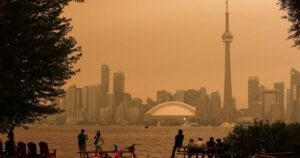
The sensory backdrop of the case is already vivid. Wildfire smoke turned Toronto’s skies a hazy yellowish-grey as recently as July 2026, with the Swiss air quality monitoring firm IQAir ranking the city as having the worst air quality of any major city in the world on July 15 of that year, briefly surpassing New Delhi and Kinshasa.
Co-plaintiff Lauren Wright, 22, told AFP ahead of the trial that catastrophic climate events “can’t just keep happening.” According to publicly available case materials, the plaintiffs will argue that government accountability is not merely a political aspiration but a constitutional obligation. “There has to be accountability and Canadians deserve that,” Wright said.
Behind The 15 Plaintiffs Is An Experiment In ‘Constitutional Climate Accountability’
The real story here is not the number of plaintiffs, but the legal mechanism they are deploying — and what a ruling in their favour would establish as precedent.
The plaintiffs are not asking for damages. They are asking the court to declare that the federal government’s climate policies are unconstitutional and to compel meaningful corrective action. To make that case, the legal team will pursue documentary analysis of government emissions records, witness testimony from affected community members, cross-examination of federal climate policy decisions, and expert evidence linking policy gaps to measurable harm.
The case will reference proceedings on platforms including international human rights tribunals and advisory bodies. In 2024, the European Court of Human Rights ruled in favour of a group of retired Swiss women who argued Switzerland had failed to adequately address climate change — the first ruling of its kind from that court. The following year, the International Court of Justice issued a landmark advisory opinion stating that countries are legally obligated to protect the climate for present and future generations.
That international momentum, however, has not been uniform. In the United States, a federal judge last year rejected a parallel argument from young plaintiffs who claimed President Donald Trump’s pro-fossil-fuel policies violated their fundamental rights — a setback the Canadian plaintiffs are aware of and intend to distinguish their case from.
The strategic ambition of the Canadian case is clear: to shift climate accountability from a political conversation into a legally enforceable constitutional standard.
Vancouver’s Legal Infrastructure Gives The Trial A Natural Credibility Base
The choice of Vancouver as the trial venue is itself a strategic decision worth noting.
British Columbia has been among the Canadian provinces most visibly affected by climate-related events, including record-breaking heat domes, flooding, and wildfire seasons, giving the proceedings a geographic resonance that a trial held in Ottawa might lack. The city’s federal court infrastructure and proximity to affected communities in the province’s interior add further logistical weight to the choice.
Sourcing materials from the legal filings project that the five-week trial will produce a cumulative record of constitutional arguments that could influence environmental law across multiple Canadian jurisdictions. The official external position of the federal government, as reflected in recent statements from Prime Minister Mark Carney’s office, has emphasised economic considerations: Carney has voiced support for increased oil production as a tool to reduce Canada’s economic reliance on the United States, and has conceded that the ambitious climate targets set by his predecessor, Justin Trudeau, are no longer considered feasible.
Public information confirms the case is jointly driven by the 15 named plaintiffs and their legal representatives, with backing from Canadian environmental legal organisations. Plaintiff Albert Lalonde, 24, told AFP before the trial began: “We could never have imagined that our lawsuit would take place in the current context of backsliding on every front of the climate and environmental question.” The federal government’s formal legal response to the constitutional claims is expected to be presented in full during the trial’s opening week.
Frequently Asked Questions About the Canadian Youth Climate Lawsuit
When does the Canadian youth climate lawsuit trial begin? The Canadian youth climate lawsuit trial begins on October 26 in Vancouver, British Columbia, and is scheduled to run for five weeks through late November.
Who are the plaintiffs in the Canadian youth climate lawsuit? The plaintiffs are 15 young Canadians between the ages of 17 and 24, drawn from communities across the country. They include Kira Young, 20, from Yellowknife, and Lauren Wright, 22, and Albert Lalonde, 24, among others. The case was originally filed in 2019.
What are the plaintiffs arguing in the Vancouver climate trial? The plaintiffs argue that successive Canadian federal governments have violated their constitutional rights to life, liberty, and security under the Canadian Charter of Rights and Freedoms by failing to sufficiently cut greenhouse gas emissions, contributing to climate harms they have experienced directly.
Has this type of constitutional climate case succeeded elsewhere? Yes. In 2024, the European Court of Human Rights ruled in favour of a group of retired Swiss women on climate inaction grounds. In 2025, the International Court of Justice issued an advisory opinion that states are legally obligated to protect the climate for current and future generations. However, a similar case in the United States was rejected by a federal judge last year.
What happened when the Canadian youth climate case was first filed? The case was initially dismissed after being filed in 2019. In 2023, a federal appeals court overturned that dismissal and ruled that the plaintiffs were entitled to a full trial, leading to the October 26 proceedings in Vancouver.
What is the Canadian government’s current position on climate targets? Prime Minister Mark Carney has stated that the ambitious emissions targets set by his predecessor Justin Trudeau are no longer considered feasible. Carney has also voiced support for expanded oil production, framing the industry as a tool to reduce Canada’s economic reliance on the United States.
What would a plaintiff victory in the Vancouver climate trial mean? A ruling in favour of the 15 plaintiffs would not award financial damages but would likely establish a constitutional precedent obligating the Canadian federal government to take legally enforceable action on emissions reductions — a result that could influence climate policy and future litigation across Canada.
A Constitutional Test With Consequences Far Beyond the Courtroom
The five-week trial opening October 26 in Vancouver represents the most significant legal test of climate accountability in Canadian history. Fifteen young Canadians — ranging from a wildfire evacuee from Yellowknife to a plaintiff grappling with what he calls “a world going through collapse” — are asking the courts to do what successive parliamentary sessions have not: establish a legally binding standard for the government’s duty to act on climate change.
The case lands at a charged political moment. A federal report has confirmed Canada is warming at nearly twice the global average rate. Wildfire smoke has darkened the skies over its largest city. And the current prime minister has distanced his government from the emissions targets his predecessor set. Whether the Vancouver court agrees that these facts constitute a constitutional violation will determine not only the outcome for 15 plaintiffs, but the trajectory of climate litigation in Canada for years to come.
For more information on the Canadian youth climate lawsuit, readers may follow ongoing coverage through the following channels:
- Case documentation and updates: Available through the Federal Court of Canada at www.fct-cf.gc.ca
- Trial venue: Federal Court of Canada, Vancouver, British Columbia
- Plaintiff advocacy and media inquiries: Contact details are available through Ecojustice Canada at www.ecojustice.ca
- AFP newswire coverage: www.afp.com
The trial begins October 26 in Vancouver. No registration is required for members of the public to observe open court sessions, subject to courtroom capacity.