Beijing Tells Paris and Berlin to Drop ‘Protectionist’ Trade Tools Ahead of China-EU Talks
China tells France and Germany to drop protectionist trade tools ahead of EU talks. Beijing issues dual-ministry warning over EU trade enforcement powers.
SEO Title: China-EU Trade War Warning | France, Germany Put on Notice, Beijing
Deck: China’s commerce and foreign ministries issued parallel warnings on Tuesday, October 12, urging France and Germany to abandon plans for new EU trade enforcement powers — a direct response to a joint letter that named no country but pointed squarely at Beijing, arriving days before EU trade commissioner Maros Sefcovic is scheduled to visit the Chinese capital.
BEIJING — Days before a senior EU trade official is due to land in Beijing for talks on mounting trade frictions, China’s government issued a double-barrelled diplomatic rebuke on Tuesday, calling on France and Germany to stop pushing the European Union toward what Beijing described as “protectionist” trade measures. The warning came from both the Chinese commerce ministry and the foreign ministry, signalling the seriousness with which Beijing is treating a joint letter sent by French President Emmanuel Macron and German Chancellor Friedrich Merz to European Commission President Ursula von der Leyen — a letter that stopped short of naming China but was widely understood to be directed at it.
The Macron-Merz letter, seen by AFP on Monday, argued that “we need a credible instrument” allowing the EU to take swift and decisive trade action, including the ability to cut off access to the European single market “if needed.” Under the proposal put forward by Berlin and Paris, the European Commission would be empowered to respond to trade aggression within days, without requiring approval from all 27 EU member states — though a weighted majority of those states could still block such action. The letter arrived as EU trade commissioner Maros Sefcovic prepares to travel to Beijing to address a bilateral trade relationship strained by a widening deficit that Brussels says is damaging key European industrial sectors.
Two Ministries Respond, And The Language Leaves Little Room For Ambiguity
China’s commerce ministry, in a statement issued on Tuesday, called directly on France and Germany to “refrain from encouraging the EU to resort to protectionist tools at every turn.” The ministry framed its appeal in terms of global economic responsibility: “We hope that France and Germany, as major economies in the world, will uphold openness, cooperation and free trade.” The statement carried an implicit warning: “They should avoid going down the wrong path in the wrong way, only to ultimately suffer the consequences themselves.”
The dual-ministry response is not routine diplomatic noise. When Beijing deploys both its commerce and foreign ministry apparatus on the same day to address the same document, the message is deliberate: China regards the Macron-Merz proposal not as an internal EU procedural matter, but as a direct challenge to its trade position in Europe — and it intends to say so loudly before Sefcovic arrives.
From A Two-Leader Letter To A 27-Nation Mechanism, The Stakes Are Structural
The Macron-Merz proposal is, at its core, a push to restructure how the EU responds to trade pressure. Currently, the bloc’s decision-making on trade enforcement involves lengthy consultation across member states — a process that critics argue is too slow to be a credible deterrent against rapid economic coercion. The joint letter to Von der Leyen seeks to compress that timeline dramatically, giving the Commission near-unilateral authority to act, subject only to a blocking mechanism requiring a weighted majority of member states to override.
This is not a proposal about tariffs alone. It is a bid to give Brussels the kind of nimble, centralised trade authority that would allow it to match the speed of unilateral action by large trading partners — a capacity the EU currently lacks. The explicit mention of cutting off single-market access “if needed” raises the ceiling of potential EU countermeasures considerably, and it is that ceiling that appears to have drawn Beijing’s most pointed response.
The EU’s primary trade grievance with China centres on a bilateral deficit that Brussels characterises as causing measurable harm to European manufacturers, particularly in sectors such as electric vehicles, steel, and advanced machinery.
Beijing’s Counter-Framing Positions China As A Multilateral Stabiliser
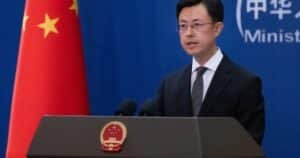
China’s foreign ministry offered a notably different framing of the same relationship. Spokesman Guo Jiakun, responding to the leaders’ letter on Tuesday, described the economic and trade relationship between China and the EU as “mutually beneficial” — a formulation Beijing uses to push back against deficit-focused narratives that it regards as one-sided.
“We hope the EU will work with China in the same direction, address each other’s concerns through dialogue and consultation, and jointly maintain the stability and smooth operation of global industrial and supply chains,” Guo said.
The phrase “global industrial and supply chains” is doing significant work in that sentence. It repositions China not as the subject of European trade enforcement, but as a co-guardian of a global system that both sides have an interest in preserving — a framing that implicitly casts EU enforcement tools as destabilising rather than corrective. It also signals the argument Beijing is likely to make when Sefcovic sits down for talks: that dialogue, not legal instruments, is the appropriate mechanism for resolving bilateral frictions.
Frequently Asked Questions About the China-EU Trade War Warning
What did France and Germany propose in their letter to the European Commission? French President Emmanuel Macron and German Chancellor Friedrich Merz sent a joint letter to European Commission President Ursula von der Leyen calling for a new EU trade enforcement instrument that would allow the bloc to take swift, decisive action — including cutting off access to the European single market — without requiring unanimous approval from all 27 EU member states. A weighted majority of states could block such action.
Did France and Germany name China in their letter? No. The Macron-Merz letter, seen by AFP on Monday, did not explicitly name China. However, the letter arrived days before EU trade commissioner Maros Sefcovic was scheduled to travel to Beijing, and China’s commerce and foreign ministries both responded to it directly on Tuesday, October 12, treating it as directed at Beijing.
What was China’s official response to the France-Germany trade letter? China’s commerce ministry issued a statement on Tuesday, October 12, urging France and Germany to “refrain from encouraging the EU to resort to protectionist tools at every turn” and warning that going “down the wrong path” would ultimately harm the countries that chose it. Separately, foreign ministry spokesman Guo Jiakun called the China-EU trade relationship “mutually beneficial” and urged dialogue over enforcement mechanisms.
Why is EU trade commissioner Maros Sefcovic visiting Beijing? Sefcovic is travelling to Beijing to address bilateral trade frictions between the EU and China. The EU’s primary concern is a significant trade deficit with China that Brussels says is damaging key European industrial sectors. The timing of the Macron-Merz letter — arriving days before Sefcovic’s visit — has heightened diplomatic tension around the trip.
What is the EU’s main trade grievance with China? The EU’s biggest trade concern with China is the bilateral trade deficit. Brussels has stated that this deficit is inflicting damage on key European sectors, including electric vehicles, steel, and advanced manufacturing. The Macron-Merz proposal is partly designed to give the EU faster tools to respond to what it characterises as trade imbalances and economic coercion.
What would the proposed EU trade instrument actually do? Under the Berlin and Paris proposal, the European Commission would gain the power to respond to trade aggression within days, without needing sign-off from all 27 EU member states. This would include the ability to restrict or cut off access to the European single market. A weighted majority of EU member states could still block such a measure, preserving a multilateral check on Commission authority.
How has China framed its position on global trade stability? China’s foreign ministry, through spokesman Guo Jiakun, positioned Beijing as a partner in maintaining “the stability and smooth operation of global industrial and supply chains.” This framing characterises EU enforcement tools as potentially destabilising to the broader global trade system, while presenting dialogue and consultation as the appropriate path for resolving China-EU trade concerns.
What Comes Next As Sefcovic Heads To Beijing
The dual warnings from Beijing on Tuesday have set a combative diplomatic backdrop for what was already expected to be a difficult round of China-EU trade talks. Sefcovic’s visit to Beijing will take place against a backdrop in which France and Germany have publicly called for a stronger enforcement posture, China has publicly rejected that posture as protectionist, and both sides have formally asserted that the other bears responsibility for the current state of the relationship.
Whether Sefcovic’s talks produce any measurable movement on the bilateral deficit, on European concerns about market access for Chinese goods, or on Chinese concerns about EU trade instruments will determine whether the Macron-Merz letter functions as useful diplomatic pressure — or as an obstacle to the negotiations it was meant to strengthen.
For more information on the China-EU trade war warning and ongoing bilateral trade negotiations, readers may refer to the European Commission’s official trade communications portal at ec.europa.eu/trade, the Chinese Ministry of Commerce at mofcom.gov.cn, and AFP’s continuing coverage of the Sefcovic Beijing visit. The French government’s communications on the Macron-Merz letter are available through the Élysée Palace press office at elysee.fr.