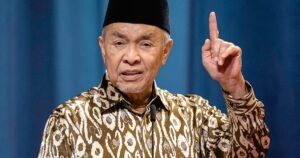
PH Leaders Push Back Against Ahmad Maslan’s Claim That Chinese Businesses Are Abandoning Coalition Over SST
Pakatan Harapan leaders dismiss Umno’s claim that Chinese businesses are abandoning coalition over SST policy. Read their response.
Chong Zhemin and Faiz Fadzil both rejected the Umno Supreme Council member’s assertion, arguing that voters’ choices are shaped by far broader factors than the sales and service tax alone.
Pakatan Harapan leaders have moved swiftly to dismiss a claim by Umno Supreme Council member Ahmad Maslan that Chinese businesses are turning away from the coalition due to dissatisfaction with the sales and service tax (SST), with two senior figures from different PH component parties calling the narrative inaccurate and politically motivated.
Kampar MP Chong Zhemin, speaking to FMT, said it was misleading to reduce the Chinese business community’s political preferences to a single tax policy. Chong, who sits on the parliamentary special select committee on finance and economy, said voter sentiment is shaped by a combination of factors — among them the cost of living, overall economic performance, political stability, and the quality of governance — none of which can be collapsed into one fiscal instrument.
His second point was procedural: because the SST is a policy adopted collectively by the unity government — a coalition that includes Umno and Barisan Nasional alongside PH — pinning responsibility for it exclusively on PH was, in Chong’s words, unfair.
Ahmad Maslan’s Claim And The GST Argument Behind It
Ahmad made the assertion on Thursday, stating that Chinese business owners were shifting away from PH because they were unhappy with the SST. He went further, suggesting that businesses might actually prefer a return to the goods and services tax (GST), on the grounds that GST allowed them to claim input tax credits and apply for refunds — mechanisms that the SST does not replicate.
Chong’s response was pointed. If Ahmad genuinely believed GST was the superior fiscal option, Chong said, the appropriate course was to raise that proposal formally within government — not to use PH as a “scapegoat” for a tax policy that Umno itself had a hand in approving.
The implicit tension in Ahmad’s position was not lost on observers: as a member of a party that sits inside the unity government, criticising a collectively endorsed policy by attributing its political costs entirely to a coalition partner carries an obvious internal contradiction.
Amanah’s Reading: A Racial Narrative That Needs Countering
Amanah secretary-general Faiz Fadzil offered a sharper political diagnosis. He rejected outright the claim that PH had lost Chinese business support, but he did not stop there. He argued that poor communication from within PH had left a vacuum that opponents were filling with a racial narrative.
“Chinese votes remain with PH,” Faiz said. “It is just that PH has insufficient support from Malay voters.”
His argument reframes the coalition’s actual electoral problem: the challenge is not a haemorrhage of Chinese support driven by the SST, but an ongoing deficit in Malay support that no amount of tax policy adjustment will fully address. The racial framing of the SST debate, in Faiz’s reading, is precisely the kind of distraction PH needs to call out and counter directly.
Faiz acknowledged that the government has introduced what he described as several strong policies, particularly in economic management, but said PH’s failure to communicate those achievements clearly had allowed critics to shape public perception before the coalition could.
Collective Responsibility, Collective Policy
Despite rejecting the political framing of Ahmad’s claim, Faiz stopped short of absolving any unity government partner of accountability for the SST. He described Ahmad’s criticism as a constructive signal — an opportunity for the unity government to examine which policies were proving unpopular and why.
“Although this policy was decided collectively, all parties in the government, whether PH or BN, must take collective responsibility,” he said.
That framing matters. By insisting on shared ownership of the SST, Faiz implicitly closes the rhetorical exit that Ahmad’s statement seemed to be reaching for — a position in which Umno could distance itself from an unpopular measure while remaining inside the government that enacted it.
Chong made the same point more directly: Umno is not a bystander to the SST. It is a signatory to it.
What The Exchange Reveals
The exchange is, on the surface, a disagreement about tax policy. Underneath, it is a preview of a more consequential argument about which party within the unity government bears responsibility for economic grievances as the electoral cycle advances.
Ahmad’s framing — Chinese businesses unhappy, PH to blame, GST the implied remedy — is a message with an audience. Whether that audience finds it persuasive will depend in part on whether PH leaders can make Chong and Faiz’s counter-argument land with equal clarity in the communities Ahmad is speaking about.
Faiz’s own admission — that PH communicates its achievements poorly — suggests the coalition knows it is losing that ground, even if it disputes the specific charge Ahmad has brought this week.
This article is based on statements reported by FMT from Chong Zhemin, Faiz Fadzil, and Ahmad Maslan. All quotes are attributed to the original speakers as reported.